
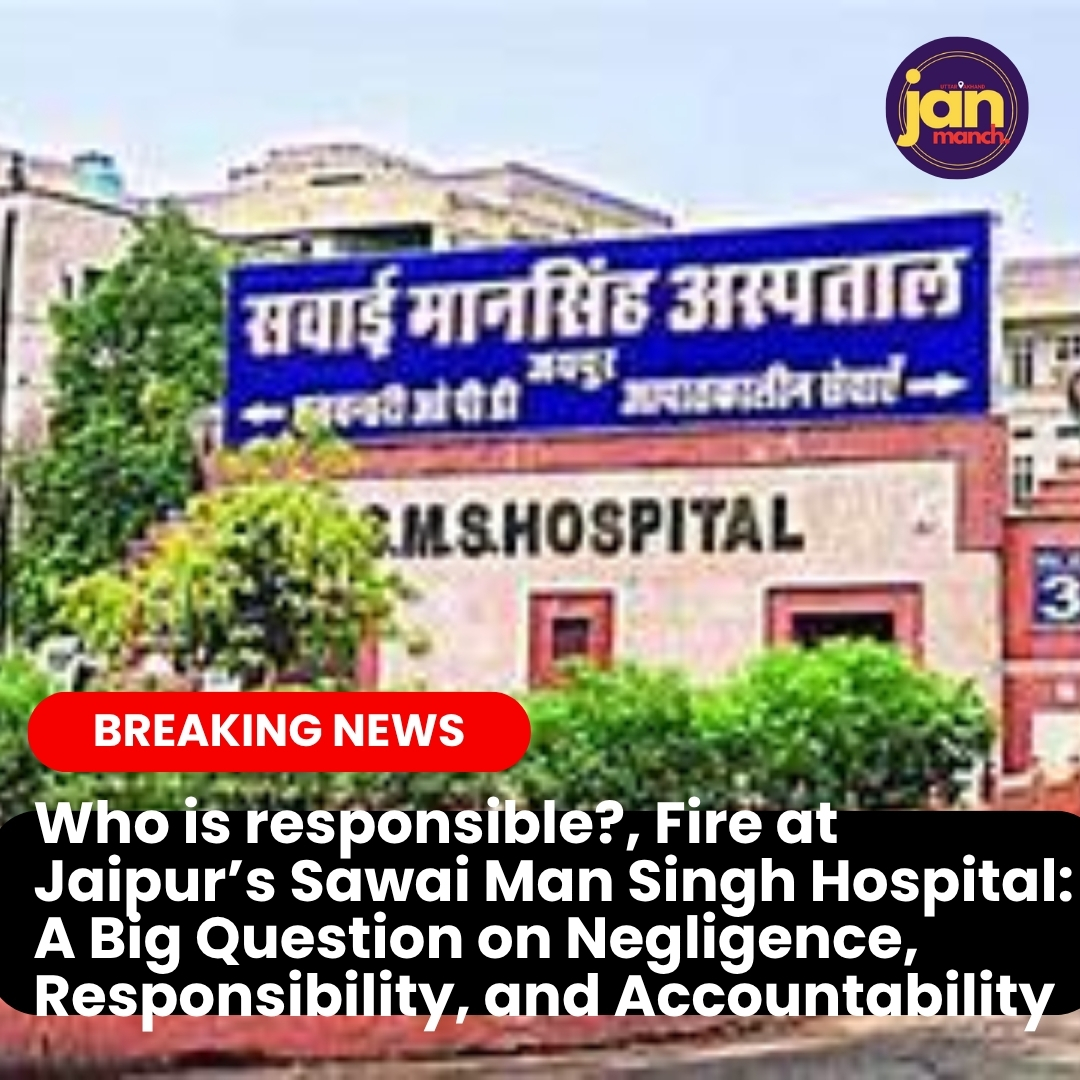

The horrific fire that broke out at the trauma center of Jaipur’s Sawai Man Singh (SMS) Hospital has shaken the entire state. Six people lost their lives and several were injured. The fire spread so rapidly that panic broke out as patients and staff rushed to escape. This was not merely an “accident,” but the result of administrative negligence, failure in safety management, and a lack of accountability.
Who was at fault?
The first question that arises is — was this tragedy caused by hospital administration’s negligence or due to excessive workload? The preliminary investigation revealed that the fire originated from a short circuit in the trauma center’s electrical panel. Ironically, this is the very place meant to save lives, yet the basic safety arrangements were found missing. Fire alarm systems were non-functional, fire exits were blocked, and staff were not trained for emergency situations. Can this really be called an “accident”? In reality, it was a man-made tragedy — born of mismanagement and neglect.
Who will bear the blame?
In such cases, the blame is usually placed on one or two individuals — an engineer, a safety officer, or a junior administrator. But can such a large institutional failure be pinned on a single person? The answer is no. The hospital management, the health department, the public works department, and above all, the state government — all share collective responsibility for this disaster. If safety standards had been regularly inspected, this incident could have been prevented.
How will the deaths be compensated?
The government has announced compensation for the victims’ families, offering a few lakh rupees as financial aid. But can a few lakh rupees truly make up for the loss of human life? This is merely a formality, not justice. True compensation will be when such tragedies never happen again — when institutions learn from their mistakes, and when the guilty face strict legal action.
Does accountability still exist?
The real question today is — does “accountability” hold any meaning in our system anymore? After every tragedy, committees are formed, reports are written, and then the matter is quietly shelved. No lessons are learned, no reforms are made. The hospital administration’s duty is not only to provide treatment but also to ensure the safety of patients. Until accountability is clearly fixed within the system, such incidents will continue to occur.
Role of the government and administration
It is the responsibility of the state government and the health department to conduct regular safety audits in all hospitals, to inspect electrical and oxygen lines periodically, and to ensure that fire safety equipment is always functional. But this will only happen when ground-level action is prioritized over paperwork.
This fire at SMS Hospital did not just burn walls — it exposed the deep-rooted failures of the system. It is time for the government and administration to take this tragedy as a lesson and make safety in health institutions a top priority. Accountability must be established, otherwise such negligence will again claim innocent lives in the future.